Home  |  About InnoCal  |  Services  |  Customer Service  |  Technical Info  |  Quote Request

Asset Management  |  Login


Measurement
Capabilities


Temperature
Humidity
Pressure/Vacuum
Airflow
Time
Volume
Rotary Motion
pH
Specific Gravity
Refractometry
Mass
Electrical


Feedback


Thermometry

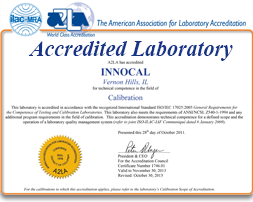
InnoCal provides quality calibration service for all styles of thermometers with our accredited (ANSI/ISO/IEC 17025:2005) temperature calibrations. From liquid-in-glass thermometers to infrared meters, our laboratory will provide you with superior service and thorough documentation to support your quality requirements.

All certifi cates are NIST-traceable unless otherwise stated. Accredited certifi cates with calculated uncertainty measurements are also available for many instrument parameters. Also, for additional points or custom selection of points, please call our technicians at 866-INNOCAL (866-466-6225) for more information. Because when quality matters, choose InnoCal, the Choice of Quality!


Liquid-in-Glass Thermometers
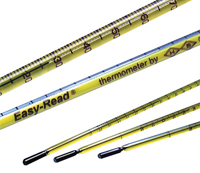
Ensure the accuracy of your ASTM, SAMA thermometers Designed by the Grand Duke of Tuscany, Ferdinand II in 1654 by using alcohol in a sealed tube. Liquid-in-glass thermometers continue to use mercury, alcohol, or spirits and are a preferred method for many ASTM and SAMA tests today. The unique characteristics of wide range, precision, repeatability, and quick response create a unique challenge for the metrologist when performing these calibrations. InnoCal’s highly-trained technicians perform calibrations within a controlled environment using high-precision Standard Platinum Resistance Thermometers (SPRTs) in calibration baths.
  • Testing range from –80 to 300°C (–112 to 572°F)
  • Calibrated at specified number of points equidistant across the range of the instrument, and include a zero-degree measurement (if thermometer includes zero on its scale)
  • Direct-comparison measurements to uncertainties as low as ±0.03°C + 1/4 of the instruments’ resolution at a 95% confidence level
  • Calibration reports include measured data, emergent stem corrections, and ice-point references as required to meet the most stringent quality and scientific requirements

Thermo-Electric Thermometry
The 1800’s saw a revolution in temperature measurement. Industrial needs for accurate, repeatable, and flexible designs not suitable for other types of instrumentation had physicists working hard developing new methods of measuring temperature. The introduction of thermocouples, resistance temperature detectors (RTDs), and thermistors offered the solution to meet a wide array of applications.

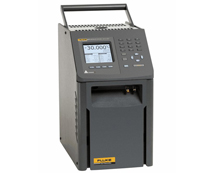
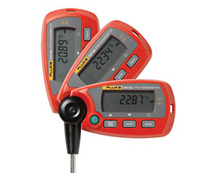
InnoCal’s highly trained technicians use direct comparison, electronic simulation, or resistance measurement methods, and perform calibrations using NIST-traceable primary or secondary standards. We are able to perform electrical simulation calibrations on Type T, J, E, K, S, R, B, C, N, and PL thermocouple meters, as well as RTD and thermistor meters from -270 to 2316°C at uncertainties as low as (K=2) ±0.21°C +0.0001/°C. Our direct comparison methods—utilizing precision SPRT’s, baths, chambers, or dry blocks, allow us to perform measurements from -80 to 1000°C at uncertainties as low as (K=2) ±0.018°C. Our calibration reports include measured data, coeffi cients, and ice-point references (if required) to meet the most stringent quality and scientific requirements.

Thermocouples
InnoCal services all styles such as bare wire, sheathed, grounded, ungrounded, or exposed junction, as well as the many different types of thermocouples such as Type J, K, T, and E.
  • Testing range from -80 to 1000°C (-112 to 1832°F) for probes and systems, -270 to 2,316°C (-454 to 4200°F) for meters
  • Tested against a NIST-traceable standard and the certificate indicates “As Found/As Left” test data
  • Tested at four points equidistant across the range of the instrument, and calibration automatically includes a zero-degree measurement as a no-charge fifth test point.
Resistance Temperature Detectors (RTDs)
RTDs are more accurate and stable than thermocouples, but cannot be used to measure extremely high temperatures.
  • Testing range from -80 to 1000°C (-112 to 1832°F) for probes and systems, and -200 to 1000°C (-328 to 1832°F) for meters
  • Tested against a NIST-traceable standard and the certificate indicates “As Found/As Left” test data at multiple temperature test points
  • Tested at four points equidistant across the range of the instrument, and calibration automatically includes a zero-degree measurement as a no-charge fifth test point.
Thermistors
Based on the principle that metal oxides change resistance with a change in temperature, thermistors have excellent accuracy over the biological or ambient temperature ranges when compared to thermocouples or RTDs. Response times are generally faster than RTD probes.
  • Testing range from -80 to 150°C (-112 to 302°F) for meters, probes, and systems
  • Tested against a NIST-traceable standard and the certificate indicates “As Found/As Left” test data at multiple temperature test points
  • Tested at four points equidistant across the range of the instrument, and calibration automatically includes a zero-degree measurement as a no-charge fifth test point


Infrared (IR)
The actual inventor of the infrared thermometer is lost to history. But we do know that in 1884, Austrian physicist Ludwig Boltzmann showed how Josef Stefan’s empirical Black Body Radiation Law, formulated in 1879, could be derived from the physical principles of thermodynamics. In the years that followed, many other physicists continued to refine the technology leading to today’s advanced infrared thermometers.

Given the convenience and versatility of IR thermometry (surface noncontact temperature readings), it’s easy to understand why this technology is very popular and used in many industries. Our calibration reports include measured data, field of view and emissivity corrections (if required) to meet the most stringent quality and scientific requirements.
  • Testing range from –12 to 500°C (10 to 932°F)
  • NIST-traceable infrared calibrations performed by using black-body calibration sources with defined emissivities
Some hand-held IR instruments today not only provide the non-contact ability, but also have a port to allow connection of a contact probe such as a thermocouple. InnoCal provides calibration service to both of these methods, the IR meter itself, the probe, or the system (meter and probe together). For complete assurance, we recommend system calibration.
Note: IR calibration is not accredited.


Bimetal or Dial Thermometers
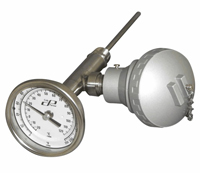
Found in many applications, these thermometers offer a quick and convenient method for measuring temperature either at the surface of a solid material or under the surface with a penetration tip. Despite the relatively simple technology or application, InnoCal understands that calibration for these instruments can be just as important as any of the most sophisticated temperature meters.
  • Testing range is from –80 to 1000°C (–112 to 1832°F)
  • Tested at three points equidistant across the range of the instrument— calibration automatically includes a zero-degree measurement as a no-charge fourth test point

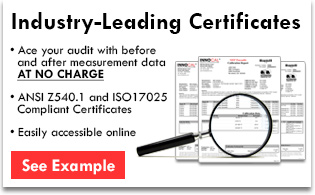
ISO 17025 Accredited certificates are available for many measurement parameters. Call our experts or view our Scope of Accreditation for more information.

For more information or to schedule service please call 1-866-INNOCAL (1-866-466-6225)


InnoCal 625 East Bunker ct. M/S 14, Vernon Hills, IL 60061-1844 1-866-INNOCAL
                  Fax: 1-847-247-2984 Email: info@InnoCalSolutions.com


Related Link: E-mail a colleague
What is Traceability?
What is Uncertainty?
Repair Services
Free Literature